Shenzhen Prechem New Materials Co., Ltd.

Application Testing of Propionate Solvents (1)
Experimental Objective
To compare the performance differences between butyl propionate and propyl propionate solvent systems and their competitor solvent systems in terms of viscosity, film appearance, gloss, etc., in order to investigate the impact of propionate solvents on the application performance of coatings and the quality of the final paint film.
Experiment and Data Analysis
1. Butyl Propionate (NBP) Test (Comparison with Xylene and Propylene Glycol Methyl Ether Acetate)
Experimental Formula:
| Component A | 80% 1136 hydroxypropyl resin + 20% Solvent |
| Component B | 60% HT-100 + 40% BAC |
| Component C | 100% Solvent |
| Formula Ratio | A : B : C = 3 : 1 : 1 |
The solvents were propyl propionate (NPP), xylene (XYL), and butyl acetate (BAC), resulting in three formulations.
Paints were prepared according to the above formulas and viscosity tests were conducted. The experimental results are as follows:
| Time (h) | XYL | PMA | NBP |
| 0 | 13.97 | 14.50 | 12.43 |
| 1 | 14.65 | 15.07 | 13.00 |
| 2 | 14.94 | 15.34 | 13.25 |
| 4 | 16.15 | 15.90 | 13.60 |
| Difference | 2.18 | 1.40 | 1.17 |

From the above data, it can be concluded that compared to XYL and PMA, NBP has better solvency, resulting in a lower viscosity after thinning. Furthermore, during the continuous 4-hour viscosity monitoring, NBP showed the smallest change in viscosity, indicating that this system has a longer pot life and higher application tolerance.
Drawdown panels were made, baked at 80°C for 1 hour, and the panel appearance was examined with related tests conducted.
| Test Item | XYL | PMA | NBP |
| Film Thickness, μm | 20.3, 32.9, 45.8 | 20.2, 35.7, 46.9 | 17.8, 28.2, 35.4 |
| Hardness | HB | HB | HB |
| Adhesion, Grade | 0 | 0 | 0 |
| Impact Resistance, Direct 50cm | Cracked | Cracked | Cracked |
| Gloss, 20/60/85° | 80.9, 92.9, 97.6 | 85.9, 93.5, 97.8 | 85.4, 93.6, 98.3 |
| Panel Appearance | |||
 | |||
The NBP system had the thinnest film, followed by XYL and PMA , which corresponds to the initial drawdown viscosity: lower viscosity results in better flow and a thinner film. The gloss of the NBP system was slightly higher, but not significantly. All three panels showed good appearance with no obvious differences.
2. Propyl Propionate (NPP) Test (Comparison with Xylene and Butyl Acetate)
Experimental Formula:
| Component A | 80% 1136 hydroxypropyl resin + 20% Solvent |
| Component B | 60% HT-100 + 40% BAC |
| Component C | 100% Solvent |
| Formula Ratio | A : B : C = 3 : 1 : 1 |
The solvents were propyl propionate (NPP), xylene (XYL), and butyl acetate (BAC), resulting in 3 formulations.
Paints were prepared according to the above formulas and viscosity tests were conducted. The experimental results are as follows:
| Time (h) | XYL | BAC | NPP |
| 0 | 13.13 | 11.40 | 11.56 |
| 1 | 13.72 | 12.03 | 12.06 |
| 2 | 13.81 | 12.19 | 12.21 |
| 4 | 14.38 | 12.38 | 12.53 |
| 6 | 14.59 | 12.65 | 12.76 |
| 7 | 14.87 | 12.75 | 12.81 |
| Difference | 1.76 | 1.35 | 1.25 |

From the above data, it can be concluded that XYL has the highest viscosity, while the viscosity and its trend of BAC and NPP are very similar, both showing better solvency than XYL.
Drawdown panels were made, baked at 80°C for 1 hour, and the panel appearance was examined with related tests conducted.
| Test Item | XYL | BAC | NPP |
| Film Thickness, μm | 19.0, 29.5, 35.6 | 15.1, 25.5, 31.6 | 16.3, 29.7, 35.1 |
| Hardness | HB | B | HB |
| Adhesion, Grade | 0 | 0 | 0 |
| Impact Resistance, Direct 50cm | Cracked | Cracked | Cracked |
| Gloss, 20/60/85° | 84.9, 93.5, 97.6 | 86.8, 94.0, 98.5 | 87.7, 95.0, 98.7 |
| Panel Appearance | |||
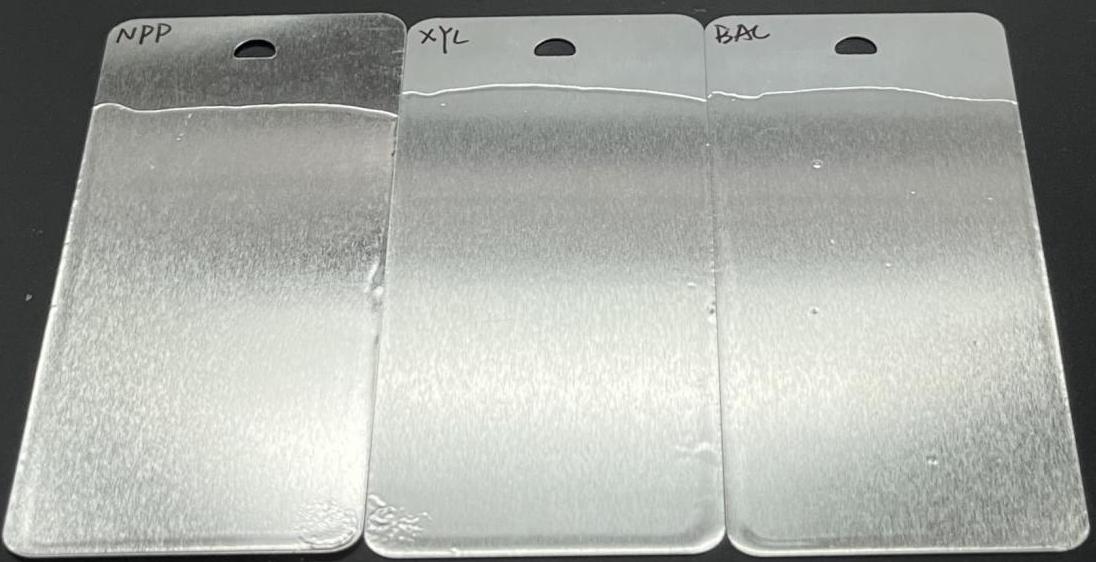 | |||
Comparison revealed that the BAC system showed relatively obvious pinholing, while the xylene system and the NPP system exhibited good panel appearance.
Summarizing the above experimental results, the NPP system showed relatively better overall performance. BAC’s viscosity was comparable to NPP, but the panel had pinholing. The XYL system showed good panel appearance, but had slightly poorer solvency and higher viscosity.
Experimental Conclusion
Performance Comparison Between Propionate Solvent Systems and Competitor Systems
| Propionate Solvent | Competitor | Gloss | Panel Appearance | Viscosity |
| Butyl Propionate (NBP) | PMA, XYL | √ | O | √ |
| Propyl Propionate (NPP) | XYL, BAC | √ | √ | √ (vs. XYL), x (vs. BAC) |
√ indicates that the corresponding propionate solvent has an advantage in that test item. x indicates a slightly lower performance. O indicates no significant difference.
 English
  Español
  Français
  Português